End-of-arm tooling safety
Guard the tool—not only the cobot arm.
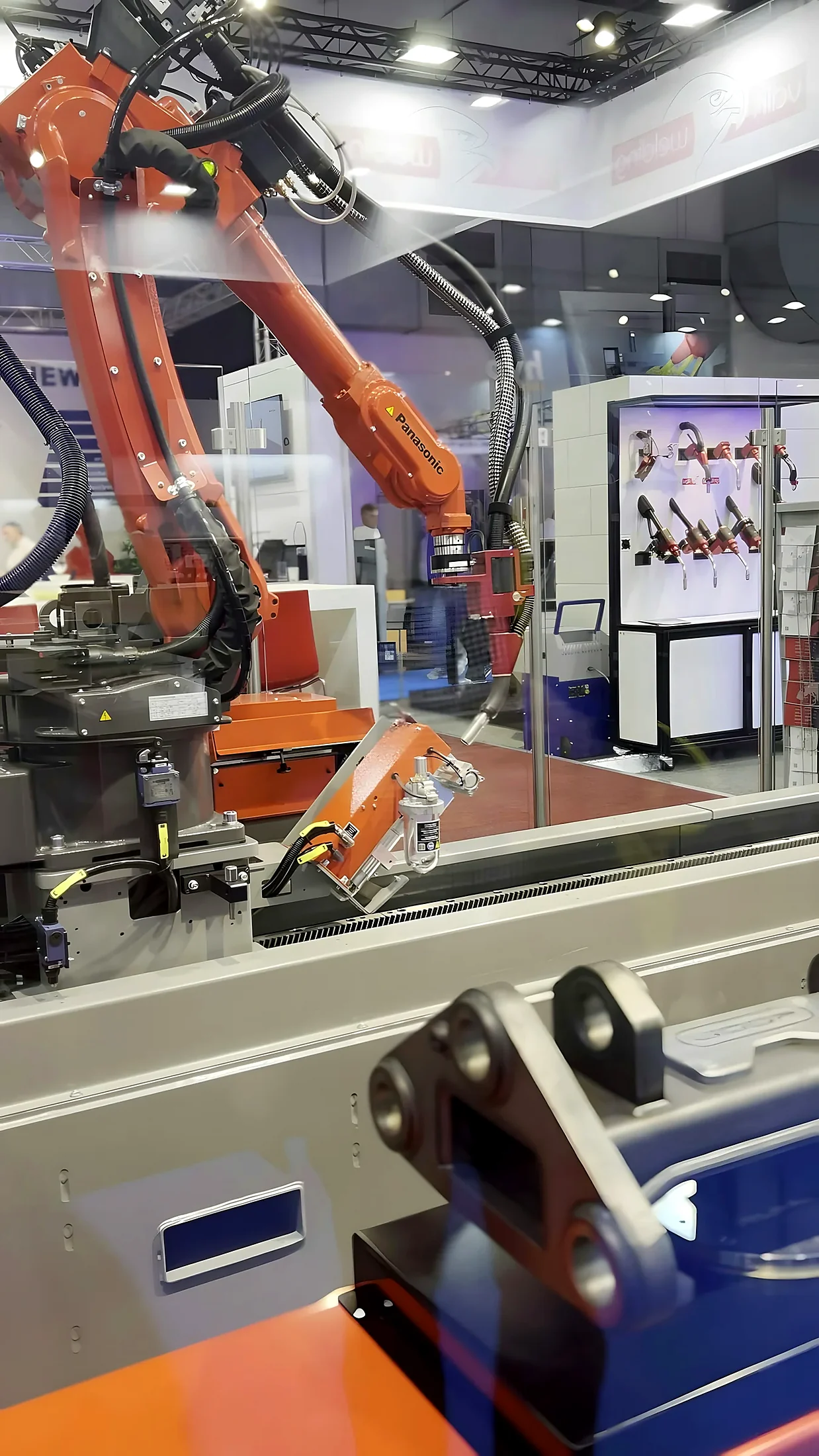
Grippers, vacuum cups, screwdrivers, dispensers, weld torches, blades and carried parts can create the decisive hazard in a collaborative robot application.
Direct answer
Can a safe cobot have an unsafe end effector?
Yes. The arm’s built-in safety functions do not automatically control pinch points in a gripper, sharp or hot tooling, stored pneumatic energy, a released workpiece or crushing against fixtures. The complete tool, payload, path and human task must be assessed together.
Reviewed by Oxford Machine Guarding technical team · 2026-09-01
Six checks before declaring a shared workspace.
End-effectors change quickly in flexible automation, so the safety review must follow every installed tool and product variant.
Accessible pinch points
Check jaws, linkages, slides, tool changers and trapping between the gripper, part, fixture or person’s hand.
Sharp and pointed geometry
Edges, fasteners, blades, needles, burrs and the workpiece itself can make foreseeable contact unacceptable.
Grip-loss behaviour
Review vacuum loss, pressure loss, power loss, control faults and whether a part can drop, slide, swing or be ejected.
Stored energy
Pneumatic, hydraulic, spring, electrical and gravitational energy may remain after the robot has stopped.
Contact surface
Mass, shape, radius, speed, contact area, body region and trapping geometry influence contact force and pressure.
Change and recovery
Tool change, jam recovery, cleaning and manual release can expose hazards that normal automatic operation does not.
Change the tool, path or access before adding complexity.
The most effective route can be a combination of safer design, restricted movement, local guarding and controlled access.
Read about PFL and separation monitoringEvery tool and product variant needs a defined envelope.
Record the approved tool, workpiece, payload, speed, path, mode and access assumptions. A different jaw, longer bit, heavier component or revised programme can create a new reach route, contact point or stopping condition.
Describe
Tool functions, energy sources and failure modes.
Map
Reach, contact, trapping and release scenarios.
Reduce
Geometry, speed, force, path and accessible points.
Protect
Local guards, sensing and safe control behaviour.
Record
Approved variants, tests and change triggers.
Show how the tool behaves when things go wrong.
Useful evidence includes drawings, photographs or video of the tool, jaw motion, product, maximum payload, utilities, grip monitoring, robot path, programmed speeds and manual-recovery method.
- Tool and robot manufacturer information
- Maximum and minimum workpiece variants
- Pressure, vacuum and stored-energy conditions
- Loss-of-grip and loss-of-power behaviour
- Operator loading, teaching and recovery tasks
 Whole applicationTool, part, robot and controls must agree on the safe state.
Use current sources and application-specific evidence.
This page is general project-planning information, not a substitute for a machine-specific risk assessment, legal advice or verification by the responsible dutyholder. Relevant standards, British adoptions and the legal route should be confirmed for the actual supply or modification.
ISO/TR 20218-1:2018: safety design for robot end-effectors · ISO 10218-2:2025: industrial robot applications and robot cells · HSE: introduction to machinery safety
Questions that prevent a tool-shaped blind spot.
No. Review cup or pad geometry, vacuum generation, loss detection, payload stability, product surface variation, failure behaviour and the consequences of a dropped part.
It may be technically possible, but a sharp or pointed tool can make close human collaboration unsuitable. Separation, restricted movement or guarding may be required.
The safety assessment should be reviewed whenever the tool change can alter geometry, mass, speed, force, reach, failure behaviour, process hazards or human interaction.
Yes, where a targeted guard adequately isolates the hazardous point and the remaining robot, workpiece, path and access risks are also controlled.
Review the complete tool path
Send the gripper, payload and access details.
We can help define local guarding, access, presence sensing and the wider safety-integration scope around the application.
Include tool exchange and tool storage in the cobot review
The end-effector review should follow a tool after it leaves the robot wrist. A detached gripper, sharp process tool or heavy change plate may still create handling, trapping or stored-energy hazards at its stand. Map the operator's complete exchange task, including approaching the stand, supporting the tool, managing services and confirming which tool is fitted.
Give the assessor the mass and handling features of each tool, the proposed storage location and the expected exchange frequency. Clarify which connections are mechanical, electrical, pneumatic or otherwise energised. The responsible designer should determine the safe exchange arrangement and the confirmation needed before operation; a matching connector alone does not prove that the correct tool and program have been selected.
Include tool identity in the approved application record alongside the carried part and robot program. Where several tools share a rack, use clear identification and an agreed check for a missing or incorrectly seated tool. This closes a practical gap between the automated task and the manual work around it. Send photographs of the existing storage and exchange method when requesting an end-effector assessment.
Should an off-robot tool stand be included in a cobot safety review?
Yes when people use it during the application. Handling, stored energy, stability and exchange tasks remain relevant away from the robot wrist.
Does a tool changer confirm that the correct application is selected?
Not by itself. Tool identity, connection confirmation and compatible program selection need an agreed control arrangement.
Review the complete cobot application Plan access and restart responsibilities